
Jiu Jitsu turns “what would I do?” into calm, practiced decision-making you can actually use.
Most people don’t want to “fight” in the real world, but most people do want a plan. That’s where Jiu Jitsu shines: it gives you a way to manage chaotic, close-range situations using control, leverage, and positioning rather than brute strength. In other words, it’s practical for regular adults, beginners, and anyone who wants confidence without aggression.
In our gym, we see the same pattern over and over: once you learn how balance, grips, and pressure really work, the world feels a little less unpredictable. You start noticing posture, distance, and exits, not because you’re paranoid, but because you’re prepared. And in a place like Green Brook, NJ, where you’re close enough to busy routes and crowded areas for things to get uncomfortable fast, that kind of readiness matters.
What makes this training feel real is that we don’t teach self-defense as a single move. We teach it as a skill set: how to stay safe, how to escape, how to control someone without escalating, and how to think while your heart rate is up.
Why Jiu Jitsu Works When Self-Defense Gets Close
Self-defense situations rarely look clean. Space collapses fast. Clothing gets grabbed. People trip, fall, or end up tangled. Jiu Jitsu is built for that range, especially once things go to the ground, where untrained instincts often fail.
A big reason Jiu Jitsu works is its focus on leverage. You learn to use skeletal alignment, hip movement, and angles to off-balance someone instead of trying to “out-muscle” them. That’s why smaller students can learn to neutralize larger training partners in a controlled environment. The goal is not to win a brawl, but to create safety.
Another reason it translates well is the emphasis on positional control. When you can stabilize a position, you can slow the situation down. Slowing things down gives you time to breathe, think, and choose the safest option available, whether that’s disengaging, escaping, or controlling until help arrives.
We also like that Jiu Jitsu gives you tools that scale. Early on you learn survival and escapes. As you improve, you learn to hold dominant positions and apply submissions responsibly. The path is progressive, which is exactly what most adults need.
The Self-Defense Skills You Build (And Why They’re Reliable)
A lot of martial arts talk about “techniques,” but real-world self-defense is more about capabilities. In class, we build those capabilities through repetition, feedback, and pressure-tested practice.
Here are a few core self-defense skills you develop through consistent Jiu Jitsu training:
• Escaping bad positions: You practice getting out from under pressure, like someone pinning you, which is more common in real confrontations than people expect.
• Controlling distance and balance: You learn how to break posture, create space, and keep someone from generating power.
• Staying calm under stress: Live training teaches your nervous system that discomfort is manageable, so you don’t freeze as easily.
• Using leverage against strength: Frames, hip movement, and angles let you protect yourself even when someone is larger.
• Choosing safer levels of force: Control positions and “hold” options help you avoid escalating when you don’t need to.
That last point is worth sitting with. The ability to control without striking is one reason Jiu Jitsu has been adopted in various law-enforcement training programs, and the outcomes reported are hard to ignore: studies and department reports show major reductions in use-of-force and injuries when grappling-based control becomes part of the toolkit.
Real-World Proof: Why Police Agencies Use Grappling-Based Tactics
We’re careful about how we talk about self-defense, because it’s serious. Still, it’s encouraging to see real-world systems choose grappling for the exact reasons everyday people do: control, restraint, and the ability to end a situation without extra damage.
In a large study of incidents from 2014 to 2020 in St. Paul, training aligned with Brazilian Jiu-Jitsu principles was associated with a 37 percent reduction in use of force across 2,845 incidents. Broader reporting around BJJ-inspired defensive tactics has shown reductions like 59 percent less overall force, 68 percent fewer strikes, 51 percent less chemical irritant use, and 44 percent fewer suspect injuries. Those numbers point to something practical: when you can control someone’s posture and movement, you often don’t need to escalate.
For civilians, the lesson isn’t “act like law enforcement.” The lesson is that control-based skills are measurable, repeatable, and safer than relying on raw aggression.
What We Teach First: Safety, Escapes, and Control
If you’re new, your first concern is usually a simple one: “Am I going to get hurt?” The honest answer is that any contact sport has risk, but Brazilian Jiu-Jitsu has been shown to have the lowest injury rate per 1,000 athlete exposures compared to judo, MMA, taekwondo, and wrestling. Even better, experience tends to reduce risk because you learn how to move, tap early, and recognize positions before they get messy.
Our beginner approach reflects that. We start with fundamentals that keep you safe and useful quickly. You learn how to fall and base, how to frame, how to protect your neck, and how to escape common pins. We’d rather you leave class feeling challenged and steady than “wrecked.”
We also coach you on training etiquette, because that’s part of safety too. Tapping is normal. Asking questions is normal. Slowing down is normal. Progress comes from consistency, not from trying to prove something on day one.
What “Realistic Training” Looks Like in Our Gym
Realistic doesn’t mean reckless. It means you practice against resistance, in a controlled setting, with clear rules and good supervision. That’s why live sparring, done responsibly, is such a big deal in Jiu Jitsu. Techniques feel different when someone is actively trying to stop you. That feedback is what turns knowledge into skill.
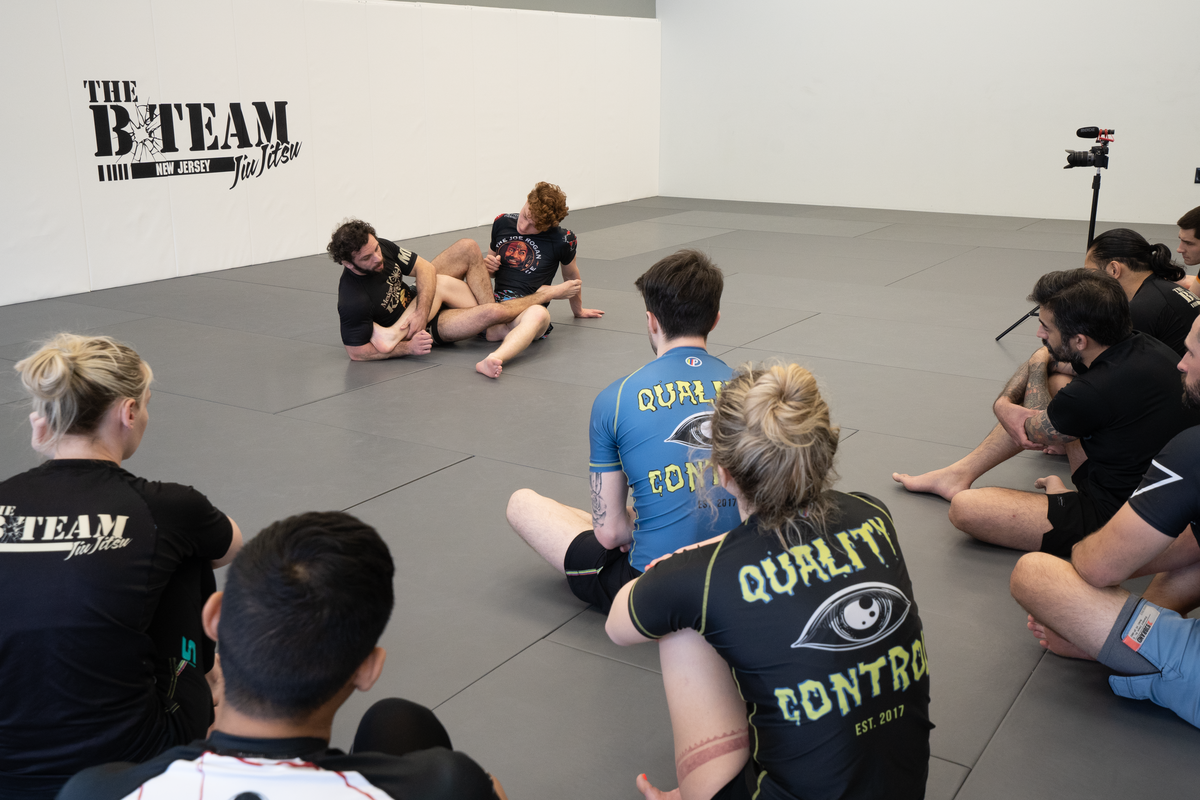
In our classes, you’ll usually move through a rhythm: learn the technique, drill it with a partner, then apply it with increasing realism. That last part is where confidence shows up. Not loud confidence, just the quiet kind where you realize you can breathe and solve problems.
We also keep training progressive. You don’t need to “know everything” to participate. You need a few reliable movements that work under pressure, and then you build from there.
Adult Jiu Jitsu in Green Brook, NJ: What to Expect If You’re Busy
Most adults in Green Brook and the surrounding area are balancing a lot: work schedules, commuting, family responsibilities, and the basic fact that energy isn’t infinite. That’s why adult training has to fit real life, not an idealized version of it.
In adult Jiu Jitsu in Green Brook, NJ, we focus on fundamentals that compound over time. You can train two or three days a week and still make meaningful progress if you stay consistent. Research on typical BJJ training patterns suggests many practitioners average around six hours per week, but you don’t have to copy a statistic to benefit. The key is a routine you can actually keep.
We also know motivation comes and goes. BJJ has a famously high dropout rate at white belt, often cited around 70 percent, with only about 1 percent reaching black belt. That’s not meant to scare you; it’s meant to clarify the real challenge: showing up. So we structure classes to feel welcoming, clear, and worth your time.
The Mental Side: Confidence You Can Feel on a Random Tuesday
One of the most underrated benefits of Jiu Jitsu is what it does for your mind. Training gives you small, regular opportunities to handle discomfort, solve problems, and reset after failure. You tap, you learn, you try again. That loop becomes a habit.
Research comparing belt levels has found that black belts report higher mental strength, resilience, self-efficacy, self-control, and life satisfaction, along with fewer mental health issues than white belts. We don’t promise anyone a magic cure for stress, but we do see how the process works: consistent training builds competence, and competence builds calm.
This matters for self-defense, too. A clear mind makes better decisions. It’s easier to de-escalate, to leave, to set boundaries, and to avoid panic. You’re not just learning to grapple, you’re learning to manage your own reactions.
Common Questions We Hear (And Straight Answers)
Is Jiu Jitsu effective against someone bigger and stronger?
Yes, because the system is built on leverage, balance, and control. Size matters, but skill changes the equation. You learn how to create angles, off-balance someone, and protect yourself without trying to overpower them.
Does Jiu Jitsu only work on the ground?
It’s strongest in ground control, but self-defense starts standing. We teach awareness around grips, clinch ranges, and how to get to safer positions. Real situations vary, so we focus on principles that carry over: posture, base, distance, and control.
Is it safe for beginners?
It can be, especially when training is structured and supervised. Brazilian Jiu-Jitsu is documented as having a comparatively low injury rate, and experienced training tends to be safer because people learn control, pacing, and how to tap early.
How long does it take to feel confident?
You’ll feel a shift faster than you think, usually once you learn a few escapes and can stay calm while pinned. “Confidence” keeps growing as your timing improves, but the first wins are often simple: breathing, framing, and getting out.
How to Get Started Without Overthinking It
Starting is easier when the steps are clear. If you want a simple plan for your first month, this works well for most new students:
1. Check the class schedule and pick two consistent days you can protect each week.
2. Show up early your first day so you can settle in, meet us, and ask questions.
3. Focus on survival basics: posture, frames, breathing, and tapping early.
4. Write down one thing you learned after each class, even if it’s small.
5. Stay patient through the awkward stage, because everyone has one.
That’s it. No heroic transformation required, just steady reps.
Take the Next Step
Building real self-defense skill is a practical project: learn reliable positions, pressure-test them safely, and repeat until calm replaces panic. That’s what we train for every day, and it’s why Jiu Jitsu remains one of the most effective systems for close-range self-defense.
When you’re ready, All in Jiu-Jitsu in Green Brook, NJ is where we bring those skills to life through structured classes, supportive coaching, and a training room that welcomes beginners and experienced students alike. If your goal is safer confidence, better decision-making under stress, and a stronger body to match, we’d love to help you start.
Put these techniques into practice by joining a Jiu-Jitsu class at All in Jiu-Jitsu.