If you want fitness results that feel measurable and practical, your workouts should build both your body and your skill.
If you have ever joined a gym in Green Brook with strong motivation and then watched that motivation fade, you are not alone. Many people start with a clear goal like losing weight, building strength, or just feeling better day to day, but the routine can get repetitive fast. We hear the same frustration all the time: you want results, but you also want something you can stick with.
That is where Jiu Jitsu changes the conversation. Instead of repeating the same movements on machines or following the same split routines, you train with purpose, partners, and a clear progression. You leave class tired, sure, but also sharper, because you learned something you can actually use.
In this guide, we will compare what you can realistically expect from Jiu Jitsu versus a traditional gym approach, specifically for people training in Green Brook. We will cover fat loss, conditioning, strength, mental engagement, accountability, and how progress feels over time, including what it looks like for adults and for Youth Jiu Jitsu in Green Brook, NJ.
What results are you really chasing: numbers or capability?
A gym is great at giving you numbers: pounds lifted, miles logged, calories estimated. Those metrics can be helpful, and we respect them. But if your goal is to feel more capable in your own body, numbers are not always the full picture.
Jiu Jitsu measures progress differently. Your improvement shows up as better balance, stronger posture under pressure, smoother movement, and the ability to solve problems in real time. You feel it when you can keep calm in a tough round, escape a position that used to trap you, or control your breathing when your heart rate spikes.
Here is the subtle difference we see in our students: gym progress often depends on you pushing yourself the same way every time, while Jiu Jitsu progress comes from learning, adapting, and staying consistent. That mental hook matters more than most people realize.
Fat loss and calorie burn: why classes tend to work faster
One of the most common reasons adults explore Jiu Jitsu in Green Brook, NJ is simple: they want to lean out without living on a treadmill. Jiu Jitsu classes typically burn a serious amount of energy, often in the range of 600 to 1,000 calories per class depending on intensity, body size, and how much live training you do.
The interval effect you do not have to force
A big reason Jiu Jitsu supports fat loss is the natural interval structure of class. You move hard, you pause, you reset, and you go again. Those bursts can spike your heart rate quickly, and then you recover, and then you repeat. You get the conditioning benefits of interval training without staring at a timer.
In a traditional gym setting, many people end up in steady-state habits. They jog at the same pace, lift with long rest periods, and do the same routine week after week. It works for a while, then plateaus show up, especially if motivation drops and intensity quietly slides.
Why fat loss feels more sustainable
Jiu Jitsu also tends to make people show up more often. That sounds almost too simple, but consistency is the real driver. If you look forward to training, you train more. If training feels like a chore, you negotiate with yourself and skip days. We build classes so you have structure, coaching, and partners to train with, which makes it much easier to stay on track.
Full body conditioning and functional strength, built the hard way
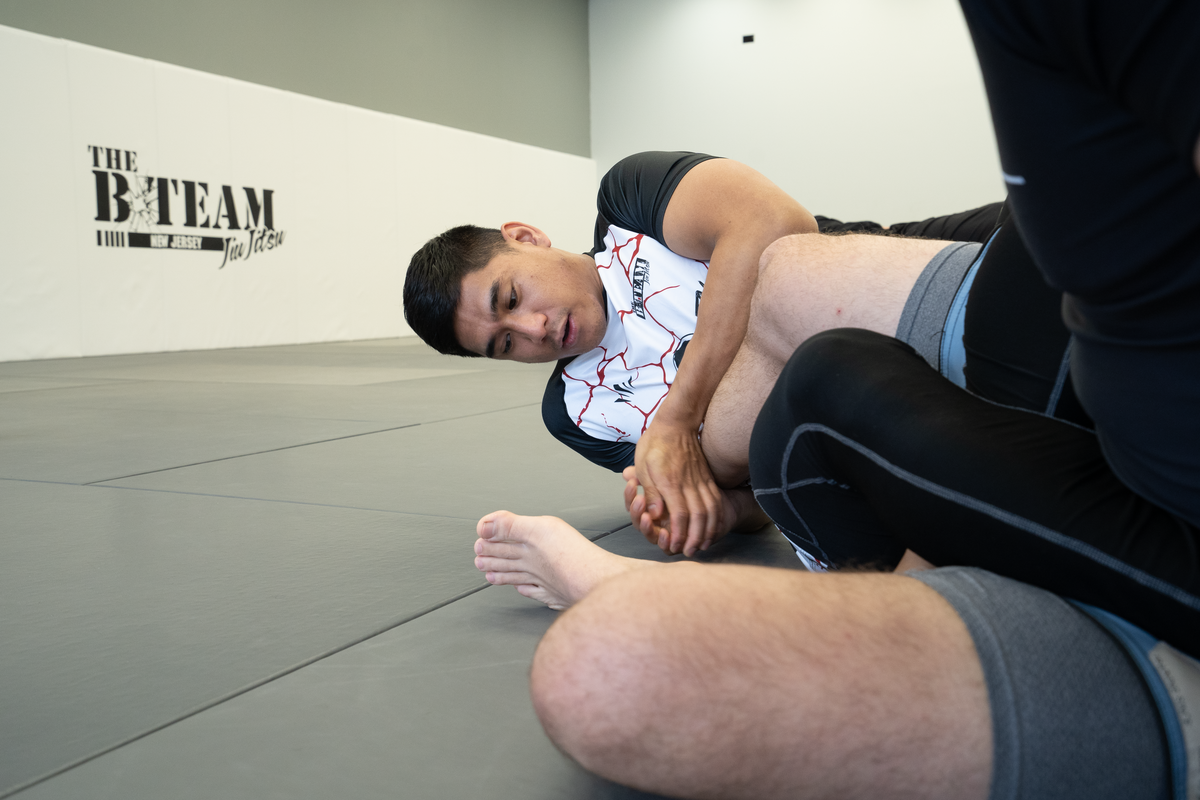
Gym training can absolutely build strength. But it often builds strength in isolated patterns: a press here, a pull there, legs on one day, back on another. In Jiu Jitsu, your body learns to connect everything at once. You bridge, shrimp, post, frame, grip, rotate, stand up, and stabilize, sometimes all within a few seconds.
Strength that shows up outside of class
Functional strength is not just a buzzword for us. It is what you notice when you carry groceries without tweaking your back, get up off the floor with more ease, or feel steadier when you move quickly. Jiu Jitsu asks your whole body to work together, and that coordination carries over into real life.
You also develop strength in awkward ranges. Real positions are rarely symmetrical or perfect. You learn to generate power while off-balance, to maintain posture while being pulled, and to keep structure when your muscles are tired. That is different from lifting a bar on rails or using machines that guide the motion for you.
Conditioning without boredom
Even when class includes drilling, it does not feel like mindless repetition. The technique has a goal, your partner gives realistic feedback, and the movement changes as you improve. When live rounds start, your conditioning gets tested in a way that is hard to replicate in a gym.
If you have ever done cardio while mentally checking out, you know what we mean. In Jiu Jitsu, you cannot check out. You are present, engaged, and reacting.
Skill progression: the missing piece most gym workouts cannot offer
A gym can teach you how to use equipment safely, and that is valuable. But after a few weeks, many people feel like they have learned the basic moves and now it is just grind. The skill ceiling feels low.
Jiu Jitsu gives you a long runway. Every class adds pieces: escapes, guard retention, passing, submissions, sweeps, and positional control. As you train, you start to recognize patterns. You build a game that fits your body and your personality. Progress feels real because it is real.
The confidence factor is not imaginary
When you learn how to control distance, posture, and leverage, you carry yourself differently. We see it in newer students all the time. You do not need to become a fighter to benefit. Just knowing you can stay composed, protect yourself, and problem-solve under pressure is a big deal.
That is one reason so many people say Jiu Jitsu changes more than their fitness. It is not motivational fluff. Skill development changes how you think.
Community and accountability: why you keep showing up
A gym can be social, but it is often anonymous. You might see the same faces, but you do your own workout with headphones on and head out. If you miss a week, nobody notices.
In our Jiu Jitsu classes, you train with partners. You learn names. You share rounds. You get coached. That creates built-in accountability, and it also makes training more fun, which honestly matters.
Here are a few ways our class environment supports consistency:
• You have a set class time, which reduces decision fatigue after work or school
• You train with partners who help you improve and keep you honest about effort
• You get coaching feedback in real time, not just a plan you hope you follow
• You see progress through technique, not only through a scale or mirror
• You have a community that makes it normal to keep coming back, even on low-energy days
That last point is important. Nobody feels unstoppable every day. What matters is that you still show up and do the work.
Self-defense and real-world practicality: a major difference
This is where the gym comparison becomes pretty clear. A gym can make you stronger, faster, and more athletic, and that can help in many situations. But it does not teach you how to control another person.
Jiu Jitsu is built around leverage, positioning, and control. You learn how to manage distance, how to get back to your feet, how to escape bad positions, and how to control someone without relying on size alone. That practicality is part of why people seek out Jiu Jitsu in Green Brook, NJ in the first place.
We keep training safe and structured, especially for beginners, because you should be able to train hard without feeling reckless. You learn skills gradually, and you pressure test them in controlled ways.
Structure and progression: why beginners do better with a clear path
One problem with gym training is that you are often responsible for building your own plan. If you love programming workouts, that can be fun. But most people want guidance. Without structure, you can drift: random workouts, inconsistent intensity, and no clear progression.
Jiu Jitsu has a natural curriculum. You start with fundamentals, you learn positional priorities, and you build step by step. We teach in a way that makes sense for brand-new students, but still stays challenging as you improve.
What a smart start looks like
If you are deciding between Jiu Jitsu and the gym, it helps to picture your first month. Here is a realistic way to begin without burning out:
1. Pick a consistent schedule you can actually keep, even on busy weeks
2. Focus on learning fundamentals before worrying about winning rounds
3. Track simple progress markers like cardio recovery and positional escapes
4. Ask questions and let coaching guide your effort level
5. Keep showing up, because consistency beats intensity spikes every time
When you train this way, you build momentum. You also avoid the classic trap of going too hard in week one and disappearing in week three.
Youth Jiu Jitsu in Green Brook, NJ: why parents like it more than basic fitness
For kids and teens, a gym is not always a great fit. Many youth programs outside martial arts are either too unstructured or too focused on conditioning without teaching skills. Youth Jiu Jitsu in Green Brook, NJ gives kids something that is both physical and mentally engaging.
We focus on movement, coordination, confidence, and respectful training habits. Kids learn how to follow instructions, how to work with partners, and how to stay calm when something feels challenging. That last piece is huge, and it carries into school, sports, and everyday situations.
Benefits that go beyond getting tired
Youth training also gives kids a healthier relationship with effort. Instead of associating exercise with punishment, they associate it with learning and progress. They learn that being bad at something at first is normal, and that improvement comes from practice. That mindset is worth a lot.
Parents often tell us our youth program helps with:
• Focus and listening skills through structured class expectations
• Confidence from learning techniques that actually work
• Physical literacy like balance, coordination, and body awareness
• Social growth through partner drills and respectful teamwork
• Healthy outlets for energy in a coached, safe environment
It is not about turning kids into tough guys. It is about giving them tools, habits, and confidence they can use.
So, is Jiu Jitsu better than the gym for most people in Green Brook?
It depends on what you mean by better. If you love lifting and you thrive on solo training, you can do great in a gym. But if you want a workout that combines fat loss, conditioning, functional strength, community, and skill development in one place, Jiu Jitsu is hard to beat.
The biggest difference is engagement. When training is interesting, you stick with it long enough to get real results. And because Jiu Jitsu constantly gives you new problems to solve, the process stays fresh even after months and years.
If your goal is to feel leaner, stronger, more capable, and more confident, our recommendation is simple: try a class and see how your body responds. Most people know within a couple of sessions whether this style of training fits them.
Take the Next Step
If you are ready for training that delivers fitness you can feel and skills you can build over time, we would love to help you get started at All in Jiu-Jitsu. Our classes in Green Brook are structured, beginner-friendly, and coached with a focus on safety, progress, and real results.
Whether you are comparing Jiu Jitsu to the gym for your own goals or looking into Youth Jiu Jitsu in Green Brook, NJ for your child, we will help you find a pace that works and a schedule you can actually maintain.
Ready to begin your training journey? Join a No-Gi Brazilian Jiu-Jitsu class at All In Jiu-Jitsu today.