
The fastest way to feel confident on the mats is to master the few fundamentals that show up in almost every round.
Starting Jiu Jitsu can feel like learning a new language with your whole body. In your first few classes, you might hear words like guard, mount, or side control and wonder how everyone seems to move with such calm purpose. We get it, and we also know the good news: beginners do not need a hundred techniques to make real progress.
Our approach is simple and structured. We focus on core positions, a small set of dependable escapes, and a few high percentage submissions so you can build skill without feeling overwhelmed. If you are looking for Jiu Jitsu in Green Brook, NJ as an adult, fundamentals are where confidence is built, one repetition at a time.
Why fundamentals matter more than flashy moves
Fundamentals are the positions and movements that keep you safe, help you breathe, and let you solve problems under pressure. Most “advanced” techniques are just smart variations built on the basics. When your base is solid, you will feel it right away: your posture improves, your timing gets sharper, and you spend less energy fighting from bad angles.
In real beginner training, fundamentals also reduce injuries. When you understand where your hips should be, how to frame, and when to slow down, your training partners feel safer too. That matters in adult Jiu Jitsu in Green Brook, NJ, where many people are balancing training with work, family, and everything else life throws at you.
The core positions you should learn first
Positions are the map of Jiu Jitsu. If you know where you are, you can decide what to do next. If you do not, everything feels like chaos. We teach beginners to recognize these core positions early, because they appear in nearly every roll.
Guard: your first home base
Guard is what you play when you are on your back and using your legs and hips to control distance. Closed guard teaches you connection and posture control, while open guard teaches you how to manage space with hooks and frames. The big idea is leverage: your legs are powerful tools, and you do not need to “bench press” someone off you to stay safe.
Side control: pressure with purpose
Side control is a dominant top position where you are perpendicular to your partner. Beginners often think side control is about squeezing as hard as possible, but clean side control is about alignment, weight placement, and denying space. On bottom, side control is where you learn the value of frames, hip movement, and patience.
Mount: stability before submissions
Mount is classic dominance: you are sitting on top of the torso with your knees tight and your weight balanced. The trap for beginners is leaning too far forward and getting rolled. We focus on staying heavy, building a stable base, and making your partner carry your weight instead of you carrying your tension.
Back control: the safest control position
Back control is powerful because it limits movement and opens up chokes. The key detail is the hooks: your feet and legs connect to the hips, and your upper body stays tight without being frantic. When you can keep someone’s back, you start to understand how control creates calm.
North south: learning to stay connected
North south can feel awkward at first. It is also a great teacher: it shows you how to stay attached while switching angles and preventing escapes. When you get comfortable here, your transitions become smoother, and your top pressure starts to feel effortless.
Your beginner checklist: movement before techniques
Before you chase submissions, learn the movements that let you escape, recover guard, and reset position. These are the “grammar” of Jiu Jitsu. Without them, you might know what you want to do, but your body cannot get there.
Here are the movements we want you to practice early and often:
- Hip escape or shrimping to create space and recover guard from side control and mount
- Bridging to break posture, disrupt balance, and start reversals
- Technical stand up to get up safely without giving up your back
- Basic framing with your forearms and hands to protect your neck and create structure
- Controlled breathing to keep your muscles from burning out too soon
If you do a little of this at home, even five minutes, your classes start to feel different fast. It is not glamorous, but it works.
Escapes first: the fastest path to confidence
Most adults come in wanting to learn how to “win.” We respect that drive, but we prioritize something more useful early on: getting safe. Escapes build confidence because they give you an answer when things go wrong. And in Jiu Jitsu, something always goes wrong at some point in the round.
Side control escapes: frames and hips
From bottom side control, your goal is to survive, build frames, and move your hips. If you turn this into a pushing contest, you will gas out. We teach you to frame at the neck and hip, make space with small movements, and slide your knee back in to recover guard.
Mount escapes: bridge with timing
Mount can feel heavy and discouraging at first, especially if your partner is experienced. The mount escape that changes everything is a smart bridge and roll. It is not about exploding. It is about trapping an arm, trapping a foot, and bridging at the right angle so your partner cannot post.
Back escape awareness: protect your neck
If someone gets to your back, your first job is hand fighting. You protect the choking side, keep your chin position disciplined, and work to get your shoulders back to the mat. This is also where breathing matters. Panic makes your hands sloppy.
A small set of beginner submissions that actually show up
We like to keep early submissions simple and repeatable. Beginners do better with a few tools used well than a dozen techniques used once. Submissions also teach control: if you cannot hold position, you cannot finish safely.
These fundamentals are common early:
- Armbar from guard, focusing on posture breaking and tight leg position
- Triangle choke, built from angle changes and controlling posture
- Americana from mount or side control, emphasizing wrist position and elbow control
- Kimura from guard or side control, using leverage and hip movement
- Rear naked choke from back control, starting with clean hand fighting
We teach you how to apply these with control, and we expect you to tap early while learning. Tapping is part of training, not a defeat. It keeps you healthy enough to come back tomorrow.
How we structure beginner classes so you improve faster
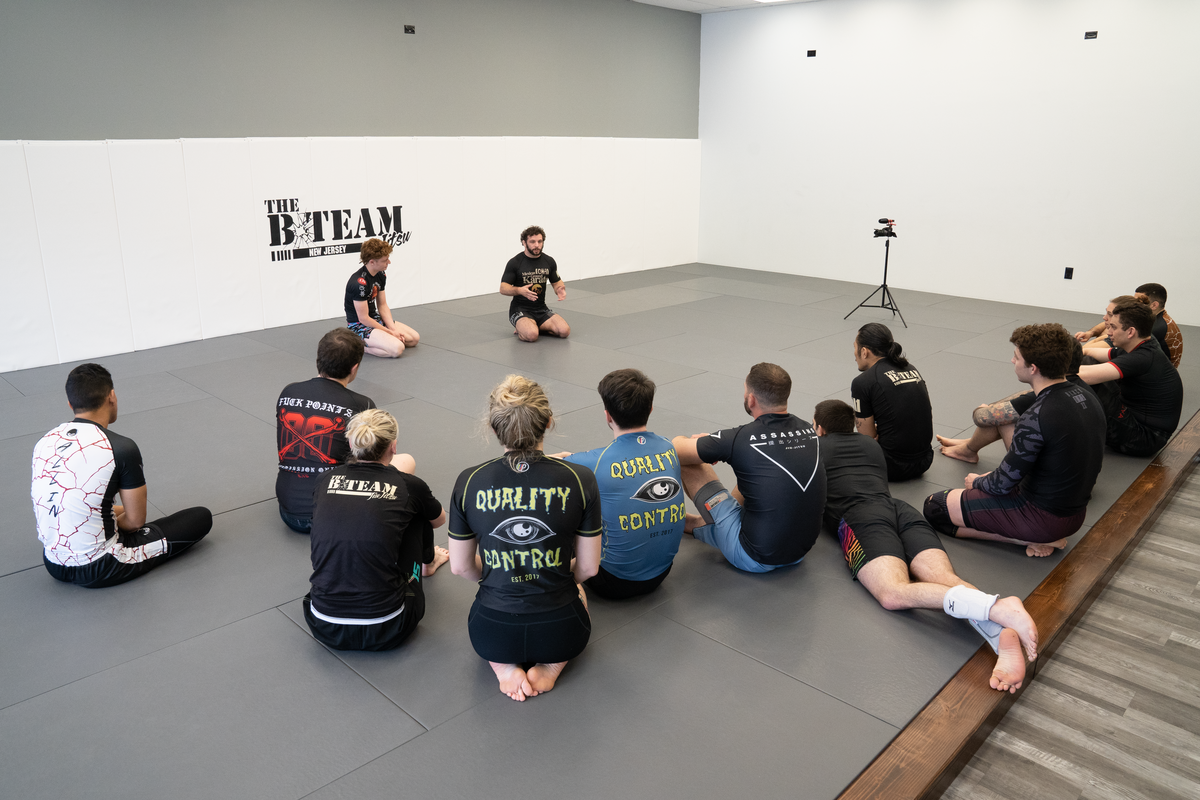
A good beginner class has a rhythm. You warm up in a way that supports the day’s technique, you learn a skill, you drill it until it feels less awkward, and then you test it with a little resistance. That last part is important, because technique only becomes real when your partner is trying to stop you.
A typical class flow often looks like this:
1. Warm ups that include mobility, hip movement, and breakfalls where needed
2. Technique instruction focused on one position and one problem to solve
3. Drilling with repetitions so your timing and mechanics improve
4. Positional rounds that start from the exact position you are learning
5. Light rolling where we emphasize safety, breathing, and decision making
If you are brand new, we will help you scale intensity. You will still work hard, but you will not be thrown into chaos without context.
Drilling, positional sparring, and flow rolling: what each one gives you
Beginners sometimes think sparring is the only way to learn. Sparring matters, but it is not the only tool, and it is not always the best tool on day one. We use different training modes to build skill in layers.
Drilling builds muscle memory. You learn where your hands go, how your hips turn, and what the sequence feels like when it is correct. Positional sparring gives you the problem repeatedly so you can improve faster. Flow rolling helps you stay relaxed and experiment without turning every exchange into a fight.
When you combine these, your progress feels steadier. You stop relying on strength and start relying on timing.
Breathing and relaxation: the skill most beginners ignore
A lot of beginners hold their breath without realizing it. The result is that you get tired fast, your grip strength disappears, and your brain feels foggy in the middle of the round. Breathing is not just a fitness tip. It is a technical skill in Jiu Jitsu because it affects how you move under pressure.
We coach you to breathe through your nose when possible, exhale when you bridge or shrimp, and relax your shoulders when you feel yourself tensing up. Relaxation does not mean being passive. It means using only the effort you need, then saving the rest for the right moment.
Safety, etiquette, and injury prevention for adult beginners
Adult Jiu Jitsu in Green Brook, NJ should challenge you, but it should also fit into your life. Staying healthy is part of training. We take that seriously, and we also expect you to do your part.
Here are a few habits that keep training safe and respectful:
- Arrive clean, with trimmed nails, and wear fresh training gear every session
- Tap early, tap clearly, and respect your partner’s tap immediately
- Communicate before rounds if you have an injury or need to train lighter
- Focus on control, especially when you are learning new submissions
- Do the warm ups, even when you are tempted to skip them after a long day
It is not complicated, but it makes a real difference. A clean, respectful room is a place where people improve faster.
What gear you need for your first class
We keep gear requirements straightforward. If you train in a gi class, you will want a gi that fits properly and a belt that matches our guidelines. For no gi, you will want fitted athletic wear that stays in place and does not have pockets or zippers.
Most beginners also choose a mouthguard, and it is a smart idea. Beyond that, bring water, show up a little early, and come ready to learn. We will handle the rest.
How often should a beginner train to see progress?
Consistency beats intensity, especially early on. Most adult beginners do best training two to three times per week. That is often enough to remember what you learned last time and build momentum without burning out. If you can add a short solo movement session at home, your progress accelerates.
We also recommend keeping a simple training note on your phone. Write down the position you worked on, one key detail, and one question to ask us next class. Those small notes add up.
Ready to Begin with All in Jiu-Jitsu
If you want to get good at Jiu Jitsu, fundamentals are the shortcut, not the slow path. When you can name the position you are in, breathe under pressure, escape reliably, and control before you submit, training becomes fun in a grounded way, even on the hard days.
At All in Jiu-Jitsu, we build our beginner experience around that structure so you always know what you are working on and why it matters. If you are searching for Jiu Jitsu in Green Brook, NJ and want a clear path from day one, we are ready to help you start strong and stay consistent.
New to Jiu-Jitsu? Start your journey by joining a Jiu-Jitsu class at All in Jiu-Jitsu.