
Your blue belt isn’t a “time served” reward, it’s proof you can learn, adapt, and apply Jiu Jitsu under pressure.
If you’re thinking about starting Jiu Jitsu, the first big question usually sounds simple: how do you go from total beginner to blue belt without feeling lost the whole time? We get it, because the early weeks can feel like learning a new language while someone is gently trying to fold you into a pretzel.
Our job is to make that path clear. In our academy, you’ll learn in steps that actually make sense: fundamentals first, then layering in timing, control, and decision-making. This guide breaks down what “progress” really looks like, what we’re watching for as you advance, and how you can train smarter in Jiu Jitsu in Green Brook, NJ.
What the White Belt Stage Is Really For
White belt is not about collecting a giant list of techniques. It’s about building a base you can stand on when things get fast. In the beginning, most students think the goal is to “win” rounds. We focus instead on helping you understand positions, safety, and the basic rules of leverage.
You’ll spend a lot of time learning how to survive. That’s not negative. Survival is a skill. If you can stay calmer, protect yourself, and keep structure when someone is applying pressure, you’re already improving in ways you’ll feel outside the gym too.
At this stage, consistency beats intensity. Two or three steady classes per week usually develops better habits than one hard session followed by a week off. Your body adapts, your timing improves, and the techniques start showing up when you need them.
The Early Wins We Expect You to Get
Progress at white belt often shows up in small, quiet moments. You stop panicking when you’re on bottom. You remember to breathe. You recognize a position before it’s too late.
A few signs you’re settling in:
- You can name basic positions and know your immediate goal in each one
- You tap early and often, then come right back with questions
- You can hold someone in your guard long enough to think
- You start noticing patterns, not just moves
Those are real milestones, and they stack up faster than you think.
Understanding the “Beginner to Blue Belt” Timeline Without Obsessing Over It
People love asking how long blue belt takes, and the honest answer is: it depends on training frequency, coaching, and how intentional you are with practice. In adult Jiu Jitsu in Green Brook, NJ, we typically see the most consistent progress from students who train year-round, communicate with our coaches, and treat fundamentals like a long-term investment.
Instead of fixating on a date, we encourage you to track measurable improvements:
- Can you escape bad positions more reliably than last month?
- Can you hold top position without burning all your energy?
- Can you explain what you’re trying to do and why?
When those answers start turning into “yes” more often, you’re on the right road.
The Core Skills We Build From Day One
Jiu Jitsu can look endless from the outside, but the foundation is surprisingly structured. We keep coming back to a few core abilities that matter at every belt level.
Position Before Submission
New students understandably want submissions. Submissions are fun. But we teach you to earn them through control. If you can’t hold position, the submission attempt often turns into you losing position and getting reversed.
So we emphasize:
- balance and base
- pressure and posture
- grip awareness
- staying tight without being tense
It’s not flashy, but it works.
Escapes and Guard Retention
A big part of white belt is learning what to do when things go wrong, because things will go wrong. If you can consistently escape mount and side control, you stop feeling trapped. If you can retain guard longer, you get more chances to attack.
As you improve, you’ll notice you’re not “surviving” randomly anymore. You’re making specific choices: framing, hip movement, recovering inside position, building back to your base.
How We Structure Training So You Don’t Feel Overwhelmed
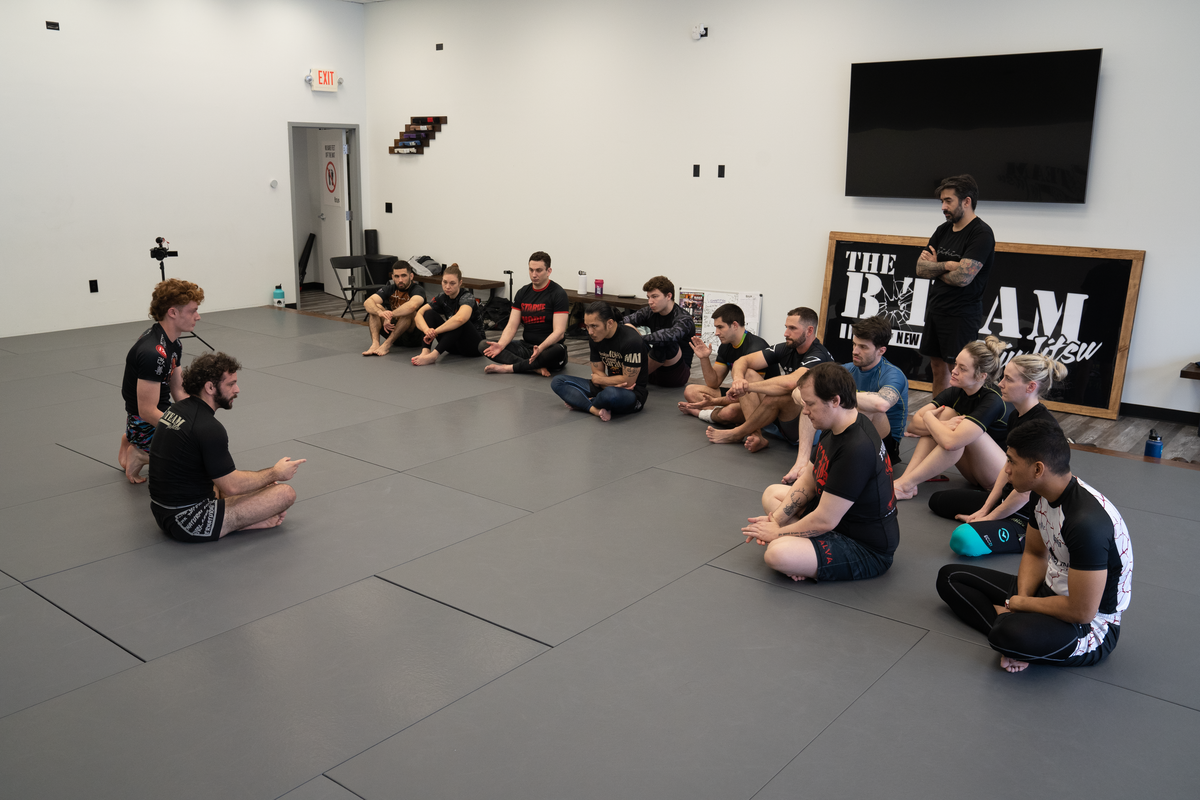
A good program doesn’t just teach moves, it organizes them. We build skills in layers, and we revisit key concepts often enough that you can actually keep them.
Here’s the rhythm many students settle into:
1. Learn a technique with clear details and a specific goal
2. Drill with control, focusing on clean reps over speed
3. Add a little resistance so you learn timing
4. Spar with safety, then review what happened
5. Return to the same positions later with new options
This loop is where growth happens. It also keeps training from feeling like random techniques floating by every week.
Rolling: How to Spar Without Stalling Your Progress
Rolling is where Jiu Jitsu becomes real, and it’s also where beginners can accidentally build bad habits. If you’re only trying to “win” training, you might rely on strength, hold your breath, or avoid uncomfortable positions forever. That slows you down.
We coach you to roll with purpose. Sometimes the purpose is survival. Sometimes it’s practicing a single escape over and over. Sometimes it’s staying relaxed while someone pressures in.
A Simple Rolling Plan That Works
If you want a practical approach that keeps you improving, try this:
- Pick one position per week where you’ll start your rounds
- Pick one escape or sweep you’ll attempt every round
- After sparring, ask us one specific question, not ten
- Write down one thing you did well and one thing you’ll fix
This isn’t complicated, but it keeps your training pointed in the right direction.
What We Look For Before Blue Belt
Blue belt should mean you can handle the basics against resistance. Not perfectly, not effortlessly, but reliably enough that your Jiu Jitsu shows up under pressure.
We’re looking for balance between defense and offense. Many students either become hard to submit but never attack, or they chase submissions and give up position constantly. Blue belt is where those two sides start to meet in the middle.
Here are the kinds of benchmarks we want to see (and yes, we help you build all of them):
- You can escape common pins with a plan, not a scramble
- You can maintain top position and progress with control
- You have at least one dependable guard you can use to sweep or stand
- You understand basic submissions and can apply them safely
- You roll with composure and can protect your training partners
That last point matters more than people expect. Control is a form of respect in Jiu Jitsu.
Common Plateaus and How We Coach You Through Them
Most students hit a plateau around the time they stop feeling “new” but don’t feel “good” yet. It’s normal. Your early progress is fast because everything is brand new. Then your brain starts noticing how deep the game is, and suddenly you feel behind.
When that happens, we simplify. We bring you back to key positions, tighten your fundamentals, and give you a narrow focus for a few weeks. Usually, that’s all it takes to break through.
Plateaus We See Often
A few patterns show up repeatedly:
- You’re trying too many techniques and remembering none
- You’re rolling too hard and getting tired fast
- You’re avoiding your weak positions
- You’re not asking for feedback, so you repeat the same mistakes
Our coaching helps you pick a lane for a bit, and progress starts feeling real again.
Training Frequency: What Works for Most Adults
Adults have schedules. Work runs late. Kids get sick. Your back feels weird on Tuesday. We understand. The best training plan is the one you can repeat.
In adult Jiu Jitsu in Green Brook, NJ, many students do well with:
- 2 classes per week to build consistency and keep momentum
- 3 classes per week to accelerate skill development
- 4 or more sessions weekly if your recovery, sleep, and stress are solid
More isn’t always better if you’re exhausted and sore all the time. We’d rather see you train consistently than burn hot for a month and disappear.
Your Gear, Hygiene, and Safety Basics (Yes, It Matters)
You don’t need a closet full of gear to start. You do need a few simple habits that keep you safe and keep the room clean.
A quick checklist we recommend:
- Keep your uniform clean and dry between classes
- Trim nails and remove jewelry before training
- Bring water, and show up a little early so you’re not rushed
- Tap early, especially while learning joint locks and chokes
- Let us know about injuries so we can adjust your training
This is part of being a good training partner. And good training partners improve faster because everyone wants to work with them.
Mindset Shifts That Make the Blue Belt Path Easier
The students who reach blue belt with confidence tend to share a few mental habits. They don’t treat mistakes like proof they “aren’t cut out for it.” They treat mistakes like information.
We also encourage you to measure progress by clarity, not chaos. If you can explain what happened in a round, even if you lost position, you’re learning faster than someone who “won” but has no idea why.
Jiu Jitsu rewards patience. It’s not always comfortable, but it’s honest. If you keep showing up, your timing gets sharper, your defense calms down, and the techniques stop feeling like separate pieces.
Take the Next Step
If you’re ready to go from beginner basics to a real blue belt level skill set, we’ve built a pathway that keeps your training structured, safe, and genuinely challenging. At All in Jiu-Jitsu, we coach the details that matter and help you track progress in a way that stays motivating, even when training gets tough.
Whether your goal is practical self-defense, improved fitness, or simply getting better at a craft that keeps unfolding, we’ll meet you where you are and guide your next steps in Jiu Jitsu in Green Brook, NJ at All in Jiu-Jitsu.
No experience is needed to begin. Join a Jiu-Jitsu class at All in Jiu-Jitsu today.